
Left Brain Stroke vs Right Brain Stroke: Same Event, Two Completely Different Outcomes

Key Takeaways

  • Which side of the brain was affected changes everything.
  • Left brain stroke takes away speech. Right brain stroke takes away the awareness that anything is wrong.
  • Personality changes after a stroke are neurological symptoms, not attitude problems.
  • Up to 80% of strokes involve risk factors you can control.
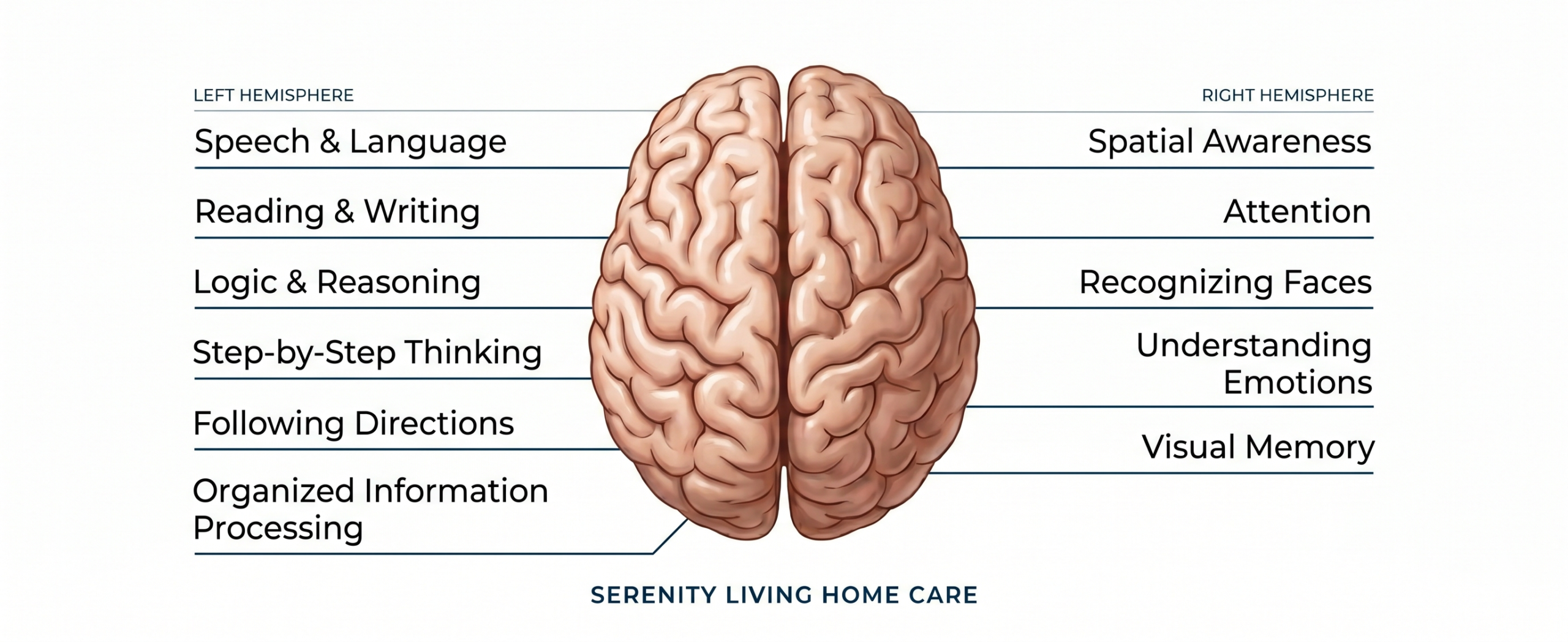
The side of the brain where a stroke happens changes everything. It changes what the person loses, how they behave, what risks to watch for, and what kind of support they need. Left brain stroke vs right brain stroke are not two versions of the same thing. They are two completely different situations.

This article tells you exactly what each one does, how to recognize it, and what to do about it.

What Is a Stroke and Why Does It Happen?

A stroke is a medical emergency that happens when the blood supply to part of the brain is cut off. The brain needs a constant flow of blood to survive. Blood carries oxygen and nutrients to brain cells. When that flow stops, even briefly, brain cells begin to die.

There are two reasons this can happen.

The first is a blockage. A blood clot gets stuck inside an artery that leads to the brain and prevents blood from getting through. This is called an ischemic stroke and it accounts for about 87% of all strokes.

The second is a bleed. A blood vessel inside or around the brain bursts and blood leaks into the surrounding tissue. This is called a hemorrhagic stroke. It is less common but often more severe.

Both types cut off blood to a specific area of the brain. And because different areas of the brain control different functions, the location of that damage determines exactly what the person loses.

The most important thing to understand about strokes is that time is brain. Every minute without treatment, the brain loses approximately 1.9 million neurons. The faster someone receives medical care, the less permanent damage occurs.

According to the Centers for Disease Control and Prevention (CDC), stroke is the fifth leading cause of death in the United States and a leading cause of long-term disability in adults. Every 40 seconds, someone in the United States has a stroke.

What Happens in the Brain During a Stroke?

The brain is divided into two halves called hemispheres. The left hemisphere and the right hemisphere each control completely different functions.

The left side of the brain is responsible for speech, language, reading, writing, logic, and step-by-step thinking. It is the side that helps a person form sentences, follow directions, and process information in an organized way.

The right side of the brain is responsible for spatial awareness, meaning the ability to judge where the body is in space, attention, recognizing faces, understanding emotions, and visual memory.

Here is what surprises most families: each side of the brain controls the opposite side of the body. The left brain controls the right arm and leg. The right brain controls the left arm and leg.

This means a stroke on the left side of the brain causes weakness on the right side of the body. A stroke on the right side of the brain causes weakness on the left side of the body.

This crossed relationship is why understanding left brain stroke vs right brain stroke matters so much when planning care.

Left Brain Stroke vs Right Brain Stroke: Side by Side


Left Brain Stroke

Right Brain Stroke

Body side affected

Right side weakness or paralysis

Left side weakness or paralysis

Speech and language

Often severely impaired

Usually preserved

Spatial awareness

Usually intact

Often significantly impaired

Does the person know something is wrong?

Yes

Often no

Behavior pattern

Slow, cautious, frustrated

Impulsive, overconfident

Personality changes

Depression, anxiety, withdrawal

Denial, mood swings, impulsivity

Biggest daily risk

Communication breakdown and isolation

Falls, wandering, unsafe decisions

Primary care focus

Communication support and patience

Supervision and safety

What a Stroke on the Left Side of the Brain Does

A stroke on the left side of the brain most commonly damages language and communication. The medical term is aphasia, which simply means the brain has lost some or all ability to produce or understand language. It does not mean the person has lost their intelligence. It means the part of the brain that turns thoughts into words has been damaged.

Common symptoms include:

  • Weakness or paralysis on the right side of the body
  • Difficulty speaking or finding words
  • Trouble understanding what others are saying
  • Challenges with reading and writing
  • Much slower processing of information
  • Needing instructions broken into one step at a time

Here is something that surprises most families: the person is usually fully aware of what they lost. They know the word they want. They simply cannot get it out. That gap between what they feel and what they can express creates frustration and depression that is very easy to misread as lack of effort.

Left brain stroke personality changes almost always include depression, anxiety, and social withdrawal. The person has not changed who they are. They are isolated behind a wall they did not choose.

What helps most:

  • Give extra time to respond and never rush
  • Use simple yes and no questions
  • Try picture boards or tablet-based communication apps
  • Keep all instructions short and one step at a time

What a Stroke on the Right Side of the Brain Does

A stroke on the right side of the brain produces a different situation, and in many everyday cases, a more physically dangerous one.

The right brain controls spatial awareness and the body’s ability to perceive itself in space. When this area is damaged, a person can stop noticing the entire left side of their world. This is called left-side neglect. Some people with this condition cannot see food on the left half of their plate. Not because their eyes do not work. Because the brain is no longer registering that side of space as real.

Common symptoms include:

  • Weakness or paralysis on the left side of the body
  • Poor spatial judgment, including misjudging distances, doorways, and stairs
  • Left-side neglect, meaning very limited awareness of the left side of the body or environment
  • Impulsive behavior and overconfidence about physical ability
  • Difficulty recognizing familiar faces
  • Memory problems related to visual and spatial information

Right brain stroke personality changes are often the most alarming for families. The person may seem cheerful and relaxed, and then try to stand without help and fall. This happens because of a condition called anosognosia, which means the brain genuinely cannot perceive its own deficits. The person is not being stubborn. The part of the brain that would recognize the problem is the part that was damaged.

What helps most:

  • Supervision is not optional, even when the person seems fine
  • Clear walking paths, grab bars, and good lighting are essential
  • Colored markers or mirrors on the left side of the environment help the brain relearn to notice that side
  • Keep communication calm, short, and consistent

Which Side Is Harder to Recover From?

Neither side is inherently worse. They are differently difficult.

A left brain stroke is often more emotionally devastating because the person is completely aware of what they lost and cannot communicate it.

A right brain stroke is often more physically dangerous in daily life because the person has no awareness of what they lost and acts on that unawareness.

What actually determines recovery is not which side was affected. It is the size of the stroke, how quickly medical treatment was received, and the consistency of daily structure and support after discharge.

Personality Changes After a Stroke

After a left brain stroke, many seniors become more anxious, more sensitive, more withdrawn, and more prone to depression. They may refuse social situations they used to enjoy.

After a right brain stroke, many seniors become more impulsive, less aware of social limits, or prone to sudden emotional outbursts that seem to come from nowhere.

In both cases, the person is not choosing this. These are neurological symptoms, the same way a fever is a symptom of infection. Knowing this changes how families respond, and that response matters more than most people realize.

How to Prevent a Stroke

The American Stroke Association states that up to 80% of strokes are connected to risk factors that can be modified. For most people, a stroke is not inevitable.

Control blood pressure consistently. High blood pressure is the single leading cause of stroke. Monitor it regularly and take prescribed medications without skipping doses.

Move every day. Thirty minutes of moderate daily activity, such as walking or swimming, reduces stroke risk by improving circulation and reducing pressure on artery walls.

Eat to protect blood vessels. The National Institutes of Health consistently highlights a diet rich in vegetables, olive oil, fish, berries, nuts, and whole grains as one of the strongest protections against stroke. High sodium and processed foods damage blood vessels over time.

Stop smoking. Smoking doubles stroke risk by damaging artery walls and making blood more likely to clot.

Know your heart rhythm. A condition called atrial fibrillation, often shortened to AFib, is responsible for 15 to 20% of all strokes. Many seniors have it without knowing. A simple cardiac rhythm check at your next doctor visit can catch it early.

Manage stress as a health priority. Chronic stress raises blood pressure, causes inflammation in blood vessels, and disrupts sleep. Daily structure, social connection, and mental engagement are protective factors supported by medical research.

According to the National Institute of Neurological Disorders and Stroke, lifestyle changes combined with medical management represent the most effective approach to stroke prevention currently available.

What to Do Right After a Stroke

Speed is the most critical factor in stroke outcomes. Use this recognition guide:

  • B for Balance: sudden loss of coordination
  • E for Eyes: sudden vision changes
  • F for Face: drooping on one side
  • A for Arms: one arm drifts down when raised
  • S for Speech: slurred or absent speech
  • T for Time: call 911 immediately

After the hospital, the first three months are the most neurologically critical. The brain is most capable of forming new connections during this window and it does not stay open forever.

The most important actions during this period are:

  • Attending every therapy appointment without exception
  • Maintaining a structured and predictable daily routine
  • Prioritizing quality sleep, as the brain does significant repair work during sleep
  • Managing nutrition carefully because brain recovery requires a lot of energy
  • Having consistent trained caregiving support, not rotating or irregular care

The most common reason recovery plateaus after a stroke is not the severity of the event. There is inconsistency in daily structure after discharge.

Recovery looks different depending on which side was affected.

After a left brain stroke, recovery centers on communication. Speech therapy is the priority, and progress is slow because the person is aware of every setback. That awareness is both the motivation and the burden.

After a right brain stroke, recovery centers on safety. The challenge is not physical. It is behavioral. The person feels ready for things they are not ready for, and explaining that does not help because the part of the brain that would process that information is exactly the part that was damaged.

In both cases, the brain responds to one thing above everything else: consistency. Every skipped appointment and every disrupted routine is a week the brain is not building the connections it needs. Recovery is not linear. But it is cumulative. Every consistent day counts.

How Assisted Living Supports Brain Health After a Stroke

Serenity Living Home Care does not offer stroke rehabilitation services. What the medical research consistently shows, however, is that the daily environment a senior lives in after a stroke is one of the strongest predictors of long-term quality of life. A structured, small assisted living home provides what recovery without professional support often cannot.

Consistent daily routine: The brain responds to predictability after any stroke. Fixed meal times, activity schedules, and reliable daily patterns reduce cognitive strain and support neural stability.

Daily supervised movement and activity: Residents at Serenity Living Home Care participate in weekly activities that keep the brain active and circulation healthy. These include:

  • Music therapy
  • Brain games and puzzles
  • Arts and crafts
  • Chair exercises and light physical activity
  • Group social programming

Social connection: Isolation increases depression and is directly linked to higher rates of secondary stroke. In a six-resident home, meaningful daily connection happens as part of normal life.

Professionally managed nutrition: Every meal at Serenity Living is approved by a registered dietician with personalized plans for each resident. Managing sodium, cholesterol, and nutrients consistently is one of the most effective ways to reduce secondary stroke risk.

Medication monitoring around the clock: Missed blood pressure medications are one of the most preventable causes of secondary strokes. Serenity’s staff handles medication reminders and monitoring 24 hours a day.

A safe and calm environment: Our Palm Beach Gardens locations are designed for seniors who need structure, safety, and genuine personal attention. Six residents means every person is known, watched over, and cared for as an individual.

Conclusion

Understanding left brain stroke vs right brain stroke is practical knowledge that changes how families communicate, plan, and respond in the days and months after a stroke. When the left brain is affected, the person needs patience, communication tools, and emotional support. When the right brain is affected, the person needs supervision, a safe environment, and consistent structure. Both situations require the same foundation: a daily life that is stable, supported, and professionally managed.

At Serenity Living Home Care in Palm Beach Gardens, Florida, we provide exactly that. Our small six-resident home offers 24-hour care, supervised daily activity, dietician-approved nutrition, and medication management for seniors who deserve attentive and consistent support.

If your family is navigating life after a stroke, we are here. Book a free tour and see the difference a dedicated small home makes.

Frequently Asked Questions about Left Brain Stroke vs Right

A right-sided stroke affects the left side of the body and damages spatial awareness and safety judgment. A left-sided stroke affects the right side of the body and damages speech and language. The key difference is that people after a left-sided stroke know something is wrong. People after a right-sided stroke often do not.

The left side. It receives a higher blood supply, which makes it more vulnerable to the clots and blockages that cause most strokes. This is also why aphasia, the loss of language ability, is one of the most common outcomes families face.

It depends on the person. Right brain strokes are often harder to manage daily because the person is unaware of their own limitations, which leads to falls and unsafe decisions. Left brain strokes are often emotionally harder because the person knows exactly what they lost but cannot express it. At Serenity Living Home Care, both situations require structured daily support, not just medical care.

A left brain stroke damages speech and language, causing difficulty speaking, understanding, reading, and writing, along with right-side body weakness. A right brain stroke damages spatial awareness and self-perception, causing left-side neglect, impulsivity, and poor safety judgment. Each type requires a different care approach.

A stroke on the left side of the brain typically damages language centers, causing aphasia, right-side weakness, slow information processing, and a strong tendency toward depression and withdrawal.

A stroke on the right side of the brain damages spatial processing, attention, and self-awareness. Common results include left-side neglect, poor judgment of physical risks, impulsive behavior, and emotional instability.

Left brain strokes are slightly more common, particularly in right-handed individuals, due to differences in blood supply patterns in the dominant hemisphere.

Yes. Personality changes after a stroke are direct neurological effects of brain damage, not character changes. Left brain stroke personality changes typically include depression and withdrawal. Right brain stroke personality changes typically include impulsivity and emotional instability.

Neither is definitively more dangerous. Right brain strokes often create more immediate physical safety risks because the person is unaware of their deficits. Left brain strokes create more significant emotional and communication challenges because the person is fully aware of what they lost.

Assisted living provides consistent daily structure, supervised activity, social connection, professional nutrition management, and medication monitoring, all of which directly reduce secondary stroke risk and support long-term brain health.

Relevant Content

Download Our

Free Ebook

"Signs Your Loved One May Need Assisted Living"